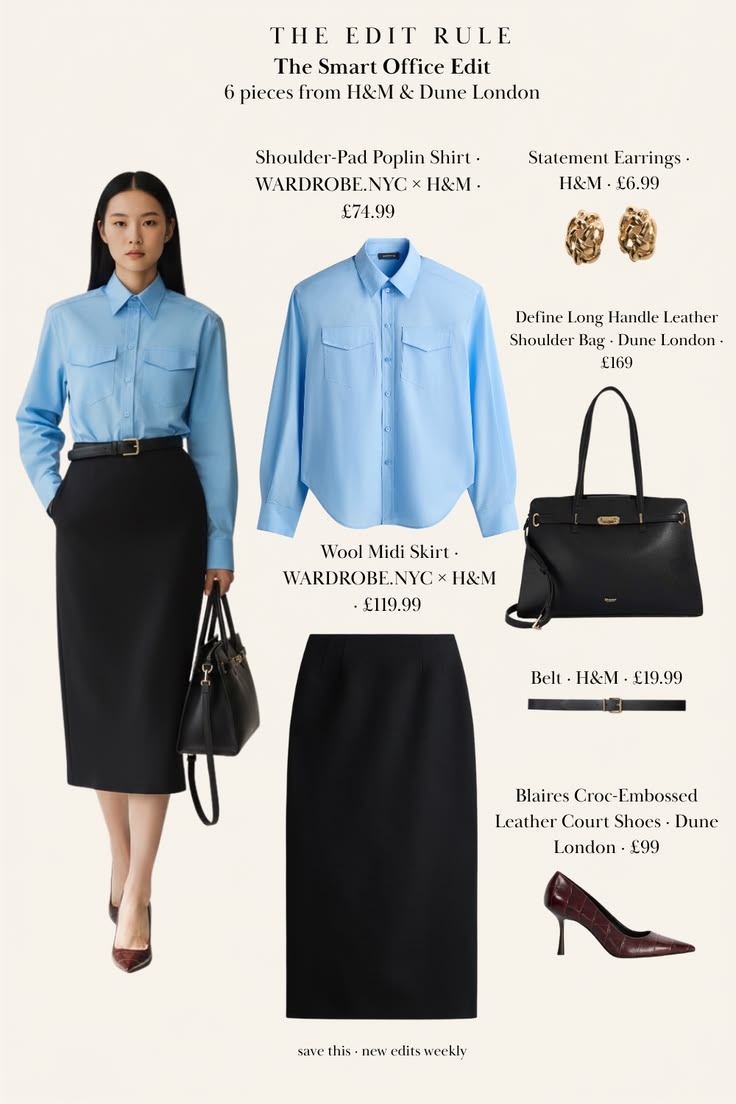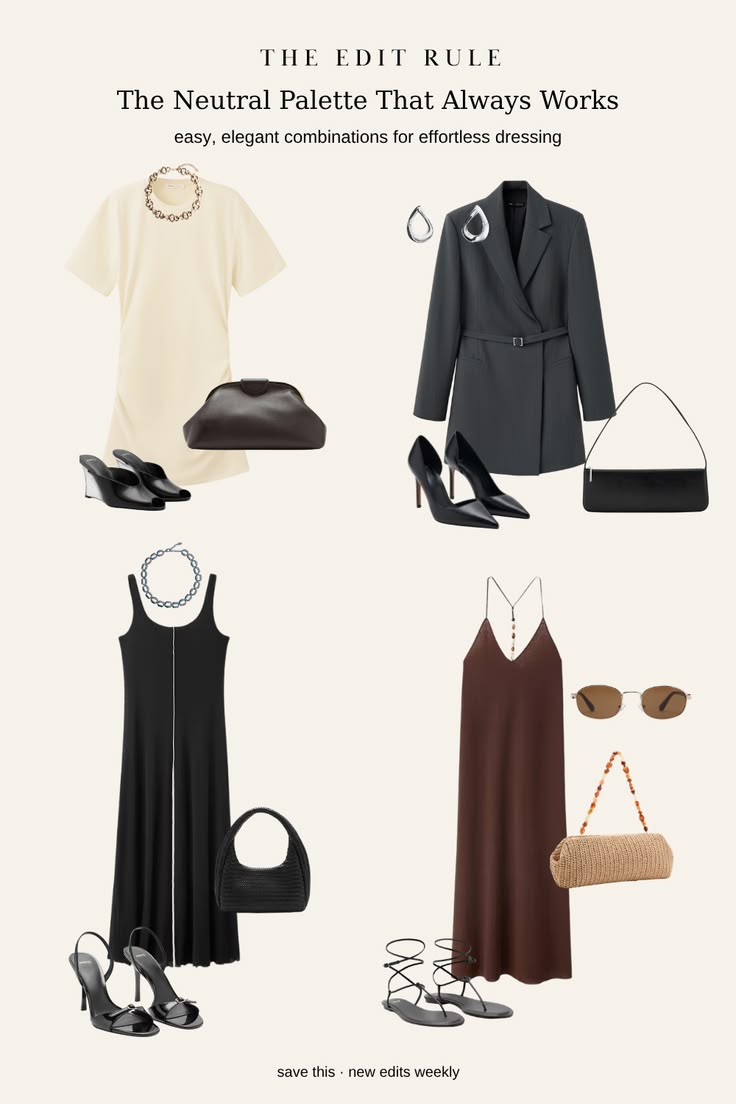
Neutral dressing has a reputation problem. It gets described as safe, which is a polite way of saying dull, and the criticism is fair when neutral means beige on beige with nothing else happening.
Done properly it is the opposite of dull. The neutral outfit ideas for work below use four colours in total, cream, black, charcoal and brown, and they produce four outfits that look nothing like each other. What changes is not the palette. It is the texture, the proportion and where the tone breaks.
The rule underneath all four
Neutrals need contrast from somewhere. If it does not come from colour, it has to come from texture or from tone.
Three cream pieces in the same fabric read as a uniform. Three cream pieces in linen, wool and leather read as an outfit. Same colour, completely different result, and it costs nothing extra.
Keep that in mind through the four formulas below, because it is the only thing they share.
Formula one: the relaxed t-shirt dress
A cream or stone t-shirt dress, a leather belt in brown at the natural waist, and flat sandals or loafers.
The dress on its own is shapeless by design. The belt is what turns it into an outfit, and it does two things at once: it creates a waist, and it introduces the brown that stops the whole thing reading as one continuous block.
Add a charcoal knit over the shoulders if the day requires it. Not tied at the neck, just carried or draped, which softens the top half without adding a third colour.
The point: one accessory turning a plain garment into a shape.
Formula two: the slip dress with a raffia bag
A charcoal or black slip dress, a raffia or straw bag, and flat leather sandals.
This is the formula that surprises people, because a slip dress is usually filed under evening. The raffia is what moves it. A natural woven texture against a fluid dark fabric pulls the whole thing into daylight, and it does it more effectively than changing the dress would.
Add a cream shirt over the top, unbuttoned, if you want sleeves. Now it is three neutrals and two textures and it is still, technically, a very plain outfit.
The point: texture doing the work that colour usually does.
Formula three: charcoal on charcoal, broken at the shoe
Charcoal tailored trousers, a charcoal fine knit, and a brown loafer or boot.
Tonal dressing in a single colour looks intentional only when something interrupts it. Here the interruption is at the foot, which is the least obvious place and therefore the most effective.
Keep the knit tucked, or half-tucked, so the trouser line runs from the waist. A knit worn long over trousers of the same colour is the version of this outfit that does not work, because it removes the only proportion the outfit has.
The point: one break in a single-tone outfit, placed as far from the face as possible.
Formula four: cream and black, hard split
Cream shirt or knit on top, black trousers or midi skirt below, black shoes.
The most formal of the four and the most reliable. The split at the waist is absolute, and that hard line is what makes it read as deliberate rather than accidental.
The detail that lifts it: keep the metal consistent and let it appear twice. A gold earring and a gold belt buckle. Two small things that agree with each other read as a decision. One reads as an afterthought.
The point: a clean horizontal break, and a repeated detail.
Why neutrals suit a working wardrobe
There is a practical argument as well as an aesthetic one. Neutral pieces combine with each other, which means a wardrobe of them produces more outfits per item than a wardrobe of colours does.
A green blazer works with perhaps three things you own. A charcoal one works with almost everything. Over a year that difference compounds into a wardrobe that feels larger without being larger.
There is also the matter of being remembered for the work rather than the outfit, which for a lot of people is the entire point of getting dressed for the office.
Warm neutrals and cool neutrals
This is the part that explains why two beige items you own look wrong together, and it is worth understanding once because it applies permanently.
Neutrals divide into warm and cool. Cream, camel, tan and chocolate are warm: they have yellow or red underneath. Stone, grey, charcoal and pure white are cool: they have blue underneath.
Within a family, almost anything works. Cream with camel with tan is effortless. Grey with charcoal with white is effortless.
Across families it becomes a decision rather than a default. A cool grey blazer over a warm camel knit can look muddy, and the reason is not that either piece is wrong. They are simply pulling in opposite directions and neither wins.
The reliable fix is to let one family lead and use the other only at a single point, usually the shoe or the bag. A warm outfit with one cool accessory reads as deliberate. A fifty-fifty split reads as an accident.
The daylight test. Hold two pieces together at a window, not under shop lighting. Retail lighting is warm and it makes cool neutrals look warmer than they are, which is why things that matched in the shop do not match at home.
Black is not a neutral in the same way
Worth saying plainly, because it causes more trouble than the rest combined.
Black does not blend. It sits apart from every other neutral and creates a hard stop wherever it appears. That is useful when you want a clean break, as in the fourth formula above, and unhelpful when you want a gradient.
Charcoal is the shade to reach for when black feels too severe, and it is the reason charcoal appears repeatedly on this site. It does the same job with none of the hardness, and it accepts brown accessories in a way that black never quite does.
If an all-black outfit feels flat, the fix is almost never adding colour. It is adding texture: leather against wool, or a matte fabric against something with a slight sheen.
Where neutral dressing goes wrong
Three failure modes, all fixable.
Everything in the same texture. The most common one. Add leather, or wool, or something woven.
No break in the tone. A single unbroken column of one colour needs an interruption somewhere, and the shoe is usually the right place.
Neutrals that are not actually neutral together. A cool grey and a warm camel can fight each other. Hold two pieces side by side in daylight before assuming they agree.
One thing to try this week
Take the four formulas above and check them against what is already hanging up. Most neutral wardrobes contain three of the four without the owner having noticed, because the pieces were bought separately and never put together deliberately.
The one that is usually missing is the third: the single-tone outfit broken at the shoe. It requires two pieces in the same colour, which people tend to avoid buying on the assumption that it would look like a uniform. It does not, provided something interrupts it, and it is the fastest of the four to assemble on a morning with no time.
Keep reading
- The Six-Piece Rule: How Six Items Make Ten Outfits
- The 10 Investment Pieces That Never Go Out of Style
Save this edit
Pin it to your board so it is there the next time you are standing in front of the wardrobe. Save to Pinterest