There is a version of the smart office outfit that most of us have tried and quietly abandoned. It usually involves a shirt that creases by eleven, a skirt that rides up on the walk from the station, and a pair of shoes that were chosen for the meeting rather than the day. It looks correct in the mirror at eight and looks tired by two.
This one does not do that. It is six pieces, a light blue shirt and a black wool midi skirt at the centre of it, and the reason it works has almost nothing to do with the individual items. It is the proportions.
Why a blue shirt and not a white one
The default answer for office dressing is a white shirt, and it is a perfectly good answer. But white is unforgiving in a way that light blue is not. It shows every crease, every coffee incident, and under most office lighting it reads slightly clinical.
A pale blue poplin does the same job with more tolerance. It still reads as formal, it photographs better on video calls, and it sits more kindly against most skin tones than a flat white does. If you own three white shirts and nothing else, a blue one is the most useful thing you can add.
The shirt here has a shoulder pad, and that detail matters more than it sounds. A defined shoulder line gives the whole outfit a frame. Without it, a soft shirt tucked into a straight skirt tends to collapse into a rectangle. With it, there is a shape.
The skirt is doing more work than it looks
A wool midi in black is one of the most quietly useful things you can own, and it is consistently underrated next to trousers. It works because it does two jobs at once: it is formal enough for the most conservative office and plain enough to be restyled endlessly outside it.
The length is the part to get right. A midi that ends at the narrowest point of the calf will flatter almost everyone. A midi that ends at the widest point will fight you regardless of what you spent on it. If you are between lengths, take it up rather than down. The alteration costs very little and it is the difference between a skirt you wear weekly and one you do not.
Wool is worth paying for here. A synthetic midi in this shape holds static, clings on the tube and loses its line by the end of the day. Wool does not.
The six pieces
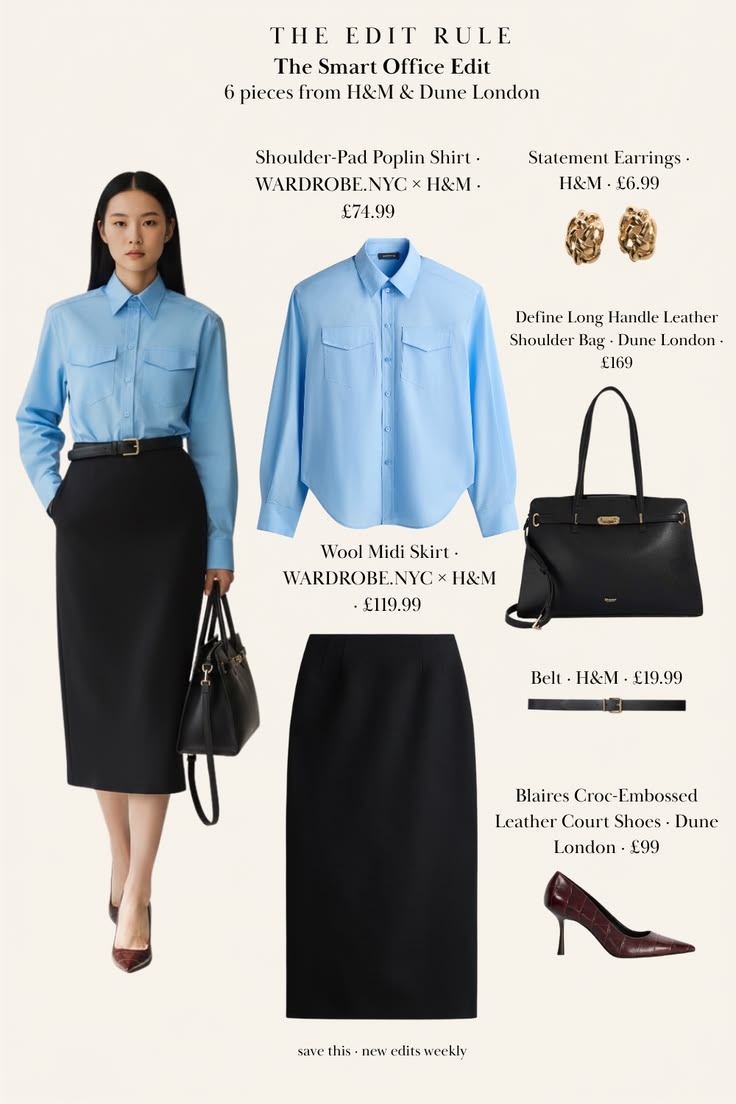
Everything below is what appears in the edit, at UK prices.
In this edit
- WARDROBE.NYC × H&M — Shoulder-Pad Poplin Shirt — £74.99
- WARDROBE.NYC × H&M — Wool Midi Skirt — £119.99
- Dune London — Define Long Handle Leather Shoulder Bag — £169.00
- Dune London — Blaires Croc-Embossed Leather Court Shoes — £99.00
- H&M — Belt — £19.99
- H&M — Statement Earrings — £6.99
What the accessories are doing
The shirt and the skirt set the shape. The other four decide whether it reads as finished or nearly finished, and each one is doing a specific job.
The belt. A thin belt at the waist is what separates a shirt tucked into a skirt from a shirt pushed into a skirt. It creates a deliberate line where the two pieces meet, and without it the eye has nowhere to stop between collar and hem.
The earrings. Gold against pale blue does the same job a scarf does in other outfits: it draws the eye up to the face. Repeating the metal in the belt buckle is what makes two small things read as one decision rather than two.
The bag. A long handle changes the proportion more than the bag itself does. It sits at the hip and continues the vertical line the skirt has already started. A short-handled bag held in the hand interrupts that line at the elbow, which is why the same outfit can look shorter with a different bag.
The shoes. The croc-embossed leather is the reason this pair lifts the outfit above a plain court shoe. Texture in a dark neutral gives you the interest of a pattern without any of the commitment, and it is the one place in this outfit where something is allowed to be decorative.
A note on the collaboration pieces
Two of the six are from a designer collaboration, and collaboration ranges behave differently from the main line. They arrive in limited quantity, they sell through quickly, and they are rarely restocked in full.
If the shirt or the skirt has gone by the time you read this, the substitutions are straightforward. For the shirt, look for a poplin with a defined shoulder rather than a soft one, in a pale blue rather than a bright one. For the skirt, look for wool or a wool blend, midi length, straight rather than pencil-fitted through the hip. The cut is the thing being copied here, not the label.
That is generally true of collaboration pieces. They are worth buying when the cut is genuinely different from what the main line offers, and worth skipping when the only difference is the label on the inside.
Three ways to wear it
The outfit is not a single look. Once the shirt and skirt exist in the wardrobe, they separate cleanly.
As it stands, with the belt, court shoes and gold earrings, it is the version for the day with the meeting in it.
Softened, with the same skirt, a fine knit instead of the shirt and flat loafers instead of the heels, it becomes the version for the ordinary Tuesday. Same silhouette, less effort, and it takes about ninety seconds to assemble.
Undone, with the shirt worn open over a vest and straight-leg jeans, the blue poplin leaves the office entirely. This is the test of whether a work piece was worth buying: whether it has a life outside the building.
What to check in the fitting room
Three things decide whether either of these pieces earns its place, and none of them are about the size on the label.
The shoulder seam on the shirt. It should sit on the edge of your shoulder, not below it. A shoulder-pad shirt that is slightly too large stops looking structured and starts looking borrowed, and it is the one thing on a shirt that cannot be altered cheaply.
The skirt at the back, not the front. Most people check a midi skirt facing the mirror. Turn around. A wool midi that pulls across the back when you sit will crease permanently along those lines within a month, and it will keep doing it after every wear.
The walk. Take ten steps in the shoes with the skirt on. A midi length that works standing still can shorten your stride enough to be genuinely irritating on a commute, and a court shoe that grips in the shop will not have improved by the second week. Neither problem gets better with wear.
None of this takes more than two minutes, and it is the difference between something that hangs in the wardrobe and something that is in the wash every week.
What this outfit is actually teaching
Strip out the specific items and the formula is: one structured shoulder, one clean vertical line, one point of contrast at the waist, and one metal repeated twice. That formula holds whichever version of it you build, and it holds with pieces you already own.
Which is the more useful thing to take away. Not the shopping list, but the reason the shopping list works.
Keep reading
Save this edit
Pin it to your board so it is there the next time you are standing in front of the wardrobe. Save to Pinterest