There is a particular kind of tiredness that comes from a full wardrobe with nothing to wear. It is rarely a shortage of clothes. It is a shortage of clothes that agree with each other.
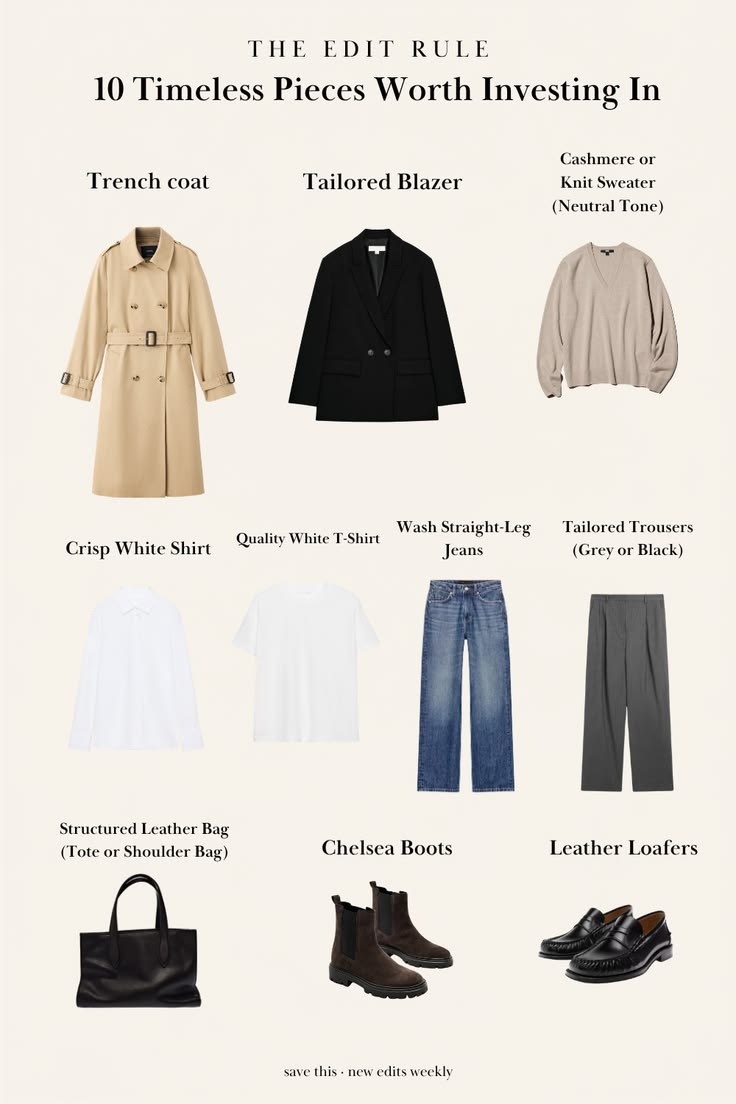
The wardrobe investment pieces below are the ones that keep turning up in every capsule worth copying, and there is a reason for that. Each one works in at least three directions: dressed up, dressed down, and layered under something else. Get these right and the rest of the wardrobe becomes much easier, because everything you add afterwards has something to attach itself to.
None of this is about spending more. It is about spending on the right ten things.
1. The trench coat
If you take one thing from this list, take this. A trench in camel or stone sits over a suit, over a jumper and jeans, over a slip dress, and it never reads as trying.
The cut matters more than the price. Look for a belt that ties rather than buckles, because a tied belt lets you adjust where the waist sits. Look for a hem that lands just below the knee: shorter and it fights a midi skirt, longer and it swamps trousers.
2. The tailored blazer
A blazer with a defined shoulder is the fastest way to make an outfit look considered. It is the difference between wearing jeans and a t-shirt, and wearing an outfit.
Navy and black are the safe answers. A soft charcoal is the one that quietly goes with more, because it sits between the two and clashes with neither. Check the sleeve length before anything else: a sleeve ending at the wrist bone makes an inexpensive jacket look expensive, and that alteration costs less than most people expect.
3. The cashmere jumper
Not a chunky one. A fine-gauge knit that fits under a blazer without bulking at the shoulder is doing three jobs: it is a jumper, it is a layer, and it is the thing that makes a summer dress work in October.
Grey, camel and navy all earn their place. Check the knit springs back when you pull gently at the cuff. If it stays stretched in the shop, it will sag by December.
4. The crisp white shirt
The most borrowed piece in any capsule wardrobe, and the one most people buy too cheaply. A poplin that holds its shape after washing will outlast three soft ones.
It is also the single item that moves most easily between the office and dinner. Worn buttoned under a blazer it is formal. Worn open over a vest with jeans it is not. Same shirt.
5. The quality white t-shirt
Heavier cotton than you think you need. The test is the neckline: it should still lie flat after four washes. A t-shirt that ripples at the collar makes everything worn over it look slightly off, and no blazer rescues it.
6. Dark-wash straight-leg jeans
Dark and unfaded reads as smart in a way that no other jean does. It is the only denim that goes under a blazer without an argument.
Anything distressed narrows where the jean can be worn, which is the opposite of what an investment piece is for. Straight leg over skinny: it holds its shape through the day and works with both a flat and a heel.
7. Tailored trousers
Charcoal goes with more than black does. Black trousers demand black shoes and a black bag to look deliberate. Charcoal accepts brown, navy and cream without complaint.
Check them sitting down, not standing. Fabric that pulls across the thigh when you sit will crease permanently along those lines within a month.
8. The structured leather tote
A long handle over a short one. The long handle sits at the hip and continues the vertical line your outfit has already started. A short-handled bag carried in the hand breaks that line at the elbow, which is why the same outfit can look shorter with a different bag.
It must fit a laptop. A work bag that does not is a weekend bag with ambition.
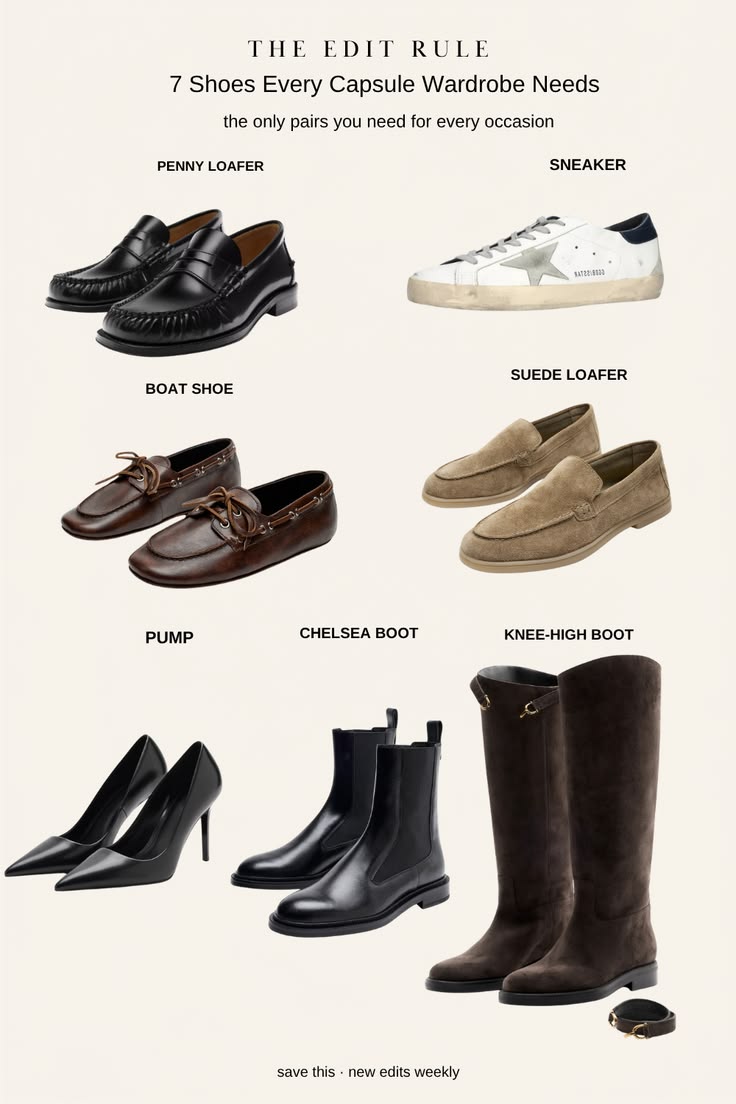
9. Leather loafers
The single most useful shoe in this list, because it is the only one that works with trousers, jeans and a midi skirt without adjustment.
Walk ten steps in the shop before deciding. A loafer that grips at the heel will not have improved by the second week, and the pair you do not wear is the most expensive pair you own.
10. Chelsea boots
The British winter answer. Check the elastic panel sits flush against the ankle rather than gaping, and check the sole is something you would happily cross a wet pavement in. A leather sole looks beautiful in the shop and is a liability in November.
What makes this list work
Read it back and you will notice something: nothing here is loud. There is no print, no logo, no piece that announces itself. That is deliberate, and it is the reason these ten combine into so many outfits rather than a handful.
A wardrobe of statement pieces gives you a set of outfits that each work exactly once. A wardrobe of quiet pieces gives you a system. The statement, if you want one, comes from you, or from one thing you add on top.
What “investment” actually means here
The word gets used loosely enough to be worth pinning down, because it does not mean expensive.
An investment piece is one where the cost per wear falls low enough to justify the price, and that calculation depends on three things: how often you will wear it, how long it will survive being worn that often, and whether it will still look right in three years.
A £400 coat worn twice a week for five winters costs less per wear than a £60 coat replaced every year, and it looks better throughout. That is an investment piece.
A £400 blazer in this season’s shoulder shape, worn to six events and then quietly retired, is not an investment piece. It is an expensive garment, which is a different thing.
This is why the ten above are all plain. Plainness is what protects the second and third parts of the calculation. A piece with no distinguishing detail cannot date, because there is nothing on it to date.
Where quality actually shows
Price and quality are related but not the same, and there are four places where the difference is visible before you buy.
The lining. Pull the jacket open. A lining sewn in cleanly at the armhole, without puckering, means the garment was assembled slowly. Puckering there almost always means corners were cut elsewhere.
The buttons. Not the button itself, the thread. A button attached with a shank, sitting slightly proud of the fabric, is meant to survive being done up over a jumper. A button sewn flat will pull the fabric.
The seam allowance. Turn a trouser inside out at the waistband. A generous allowance means the garment can be let out or taken in. A narrow one means it fits now or never.
The fabric weight in your hand. Not thickness. Weight. Hold a knit up and let it hang. If it stretches noticeably under its own weight in the shop, it will sag permanently within a season.
None of these require expertise. They take about ninety seconds in total and they are more reliable than the price tag.
Where to start
Tick off what you already own. Most wardrobes contain five or six of these already, often in a version that needs replacing rather than adding.
What is left is the useful part, and there is no correct order to it. The gap that annoys you most on a Monday morning is the one worth closing first.
Keep reading
Save this edit
Pin it to your board so it is there the next time you are standing in front of the wardrobe. Save to Pinterest