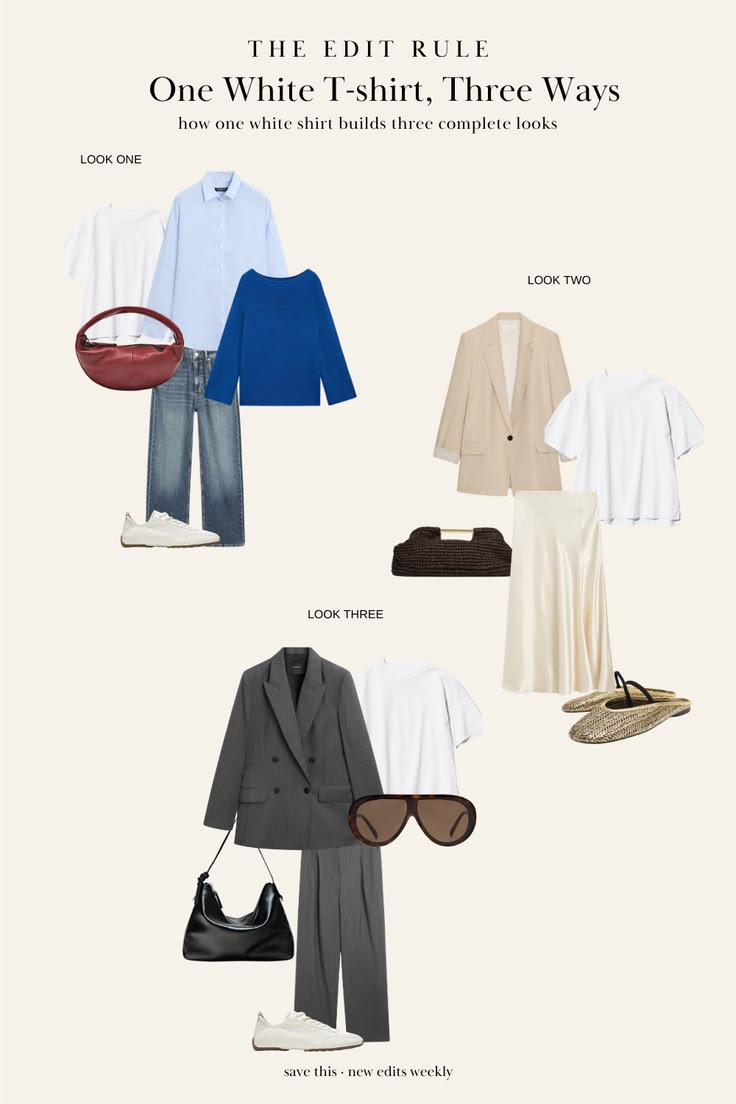
Most capsule wardrobe advice starts with a number that sounds impressive and then quietly does not survive a real week. Thirty pieces. Ten pieces. A number chosen because it reads well rather than because it works.
Six is different, because six is not the whole wardrobe. It is the working core: a capsule wardrobe of 6 pieces that carries the ordinary week, with everything else sitting around it. And six pieces chosen properly produce something close to ten distinct outfits, which is more than most people wear in a fortnight.
Here is the arithmetic, and then the reasoning underneath it.
The six
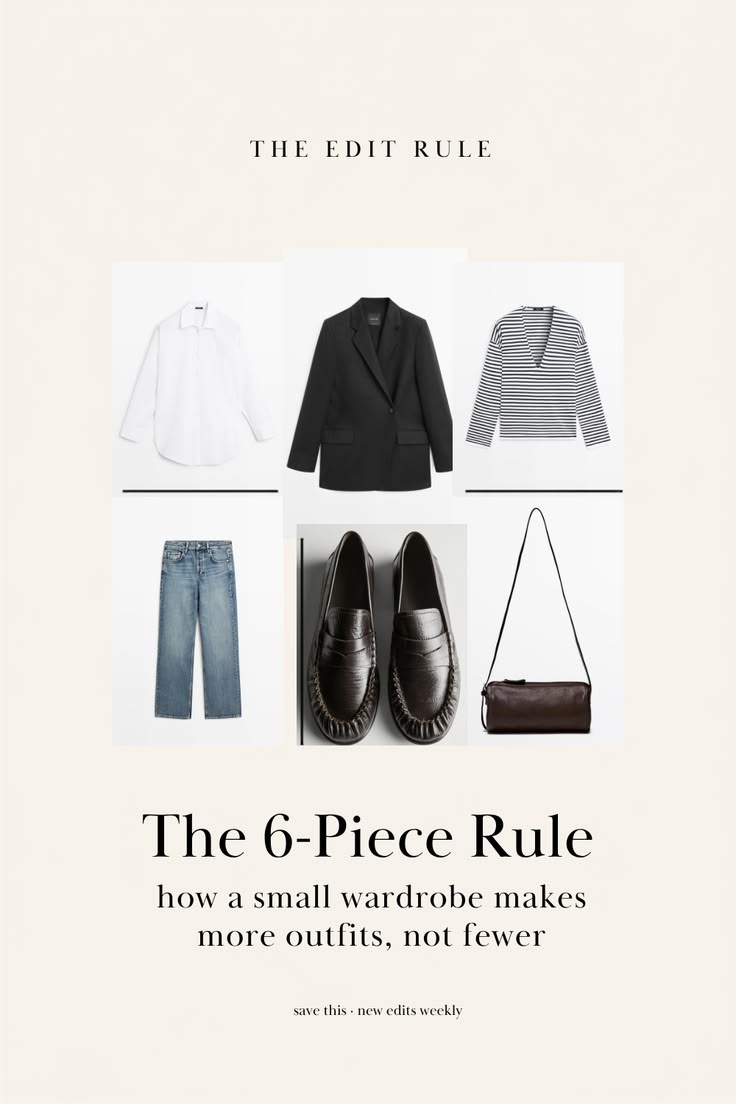
A blazer. A shirt. Straight-leg jeans. A fine knit. Loafers. A crossbody bag.
That is it. No dress, no coat, no second pair of shoes. Those come later and they attach easily, but they are not what makes the system work.
Why these six and not six others
Every piece here does at least two jobs, and no two pieces do the same job.
The blazer is outerwear indoors and structure over everything. It is the piece that decides whether the outfit reads as considered.
The shirt is a top on its own and a layer under the knit. Worn open over a vest it is a light jacket. Three functions from one garment.
The jeans are the neutral base. Dark and straight so they take a blazer without looking like weekend clothes.
The knit is warmth and it is a top. It goes over the shirt or instead of it, which is what doubles the outfit count rather than adding to it.
The loafers are the only shoe that crosses from jeans to tailoring without adjustment.
The bag is the one that leaves your hands free, which matters more on a commute than it does in a photograph.
The pieces do not overlap. That is the whole trick. Two blazers and no knit gives you fewer outfits than one of each, even though it is the same number of items.
The ten outfits
Work through the combinations and they arrive faster than expected.
Shirt with jeans and loafers. Add the blazer, and it is a different outfit. Swap the shirt for the knit, and it is a third. Knit with the shirt underneath, collar and cuffs showing, is a fourth, and it is the one that looks the most deliberate for the least effort.
Then the pieces start leaving the group. The blazer over a dress you already own. The knit over a summer skirt. The shirt open over a vest with the same jeans. The loafers with tailored trousers.
None of that requires buying anything. It requires the six to be neutral enough to attach to what is already in the wardrobe, which is the second half of the rule and the half people skip.
The part that decides whether it works
Colour. If the six pieces do not sit in the same family, the system collapses into a set of fixed outfits.
Stay within two neutrals and one accent at most. Navy, cream and black. Or camel, white and charcoal. The moment a bright green knit joins the six, it has one blazer it works with instead of all of them, and you are back to owning outfits rather than a wardrobe.
This is also why the pieces should be plain. A print commits an item to a smaller number of partners, permanently.
Choosing your six
The six above is a template, not an instruction. The right six depends on the week you actually have.
If you are in an office four days a week, swap the jeans for tailored trousers and the loafers for something with a small heel. If you work from home most days, the blazer earns less of its place and a good coat earns more, because the outfit that matters is the one you leave the house in.
The test for each piece is the same: can you name three outfits it makes with what you already own? If not, it is not one of the six, however much you like it.
What it does not solve
A six-piece core does not cover a wedding, a beach holiday or a genuinely cold January. It is not supposed to. It covers the eighty per cent of days that are just days, and it removes the decision from those days entirely.
The remaining twenty per cent is where the rest of the wardrobe lives, and it can be as impractical as you like, because it is not carrying the week.
Why six and not ten
Ten pieces produces more combinations on paper. In practice it produces fewer outfits, and the reason is decision fatigue rather than arithmetic.
A six-piece core is small enough to hold in your head. You know, standing in front of it at seven in the morning, what goes with what, because there are only a handful of answers. Ten pieces crosses the line where you start having to think, and thinking is the thing this system exists to remove.
There is also an honesty benefit. Six forces genuine choices. It is very easy to justify a tenth item and almost impossible to justify a seventh when the six are already covering the week. The constraint is doing useful work.
The maintenance problem nobody mentions
A six-piece core gets worn hard. That is the point, and it is also the catch.
Six pieces carrying five days a week means each item is worn roughly twice as often as it would be in a larger wardrobe. Cheap versions do not survive that. A knit that pills after ten wears is fine in a wardrobe of thirty jumpers and useless in a wardrobe of one.
This is the argument for spending properly on the six specifically, and being relaxed about everything else. The core is where cost per wear is lowest, so it is where money goes furthest.
Two practical habits extend the six considerably. Do not wash knitwear after every wear; airing overnight is usually enough and washing is what destroys fibres. And rotate the shoes, because leather needs a day to dry out between wears and a shoe worn daily lasts a fraction as long.
When to break the rule
The six-piece core is a working system, not a moral position.
There are three situations where it does not apply and pretending otherwise makes life harder. A genuinely physical job, where clothes are equipment rather than presentation. A job with a real uniform or dress code, where the choices are made for you. And a period of change, whether that is a new body shape, a new city or a new climate, where committing to six pieces is premature.
In all three, wait. The system works best applied to a life that has settled, and there is no benefit to imposing it on one that has not.
Start with what you own
Before buying anything, lay out the six categories and put your current best version of each on the bed. Most people find they have four of the six already, and one of them is nearly right but the wrong colour.
That gap, the nearly-right one, is usually the highest-value thing to replace. Not the missing piece. The one that is quietly stopping the other five from working together.
Keep reading
- The 10 Investment Pieces That Never Go Out of Style
- Four Outfit Formulas Built Entirely From Neutrals
Save this edit
Pin it to your board so it is there the next time you are standing in front of the wardrobe. Save to Pinterest