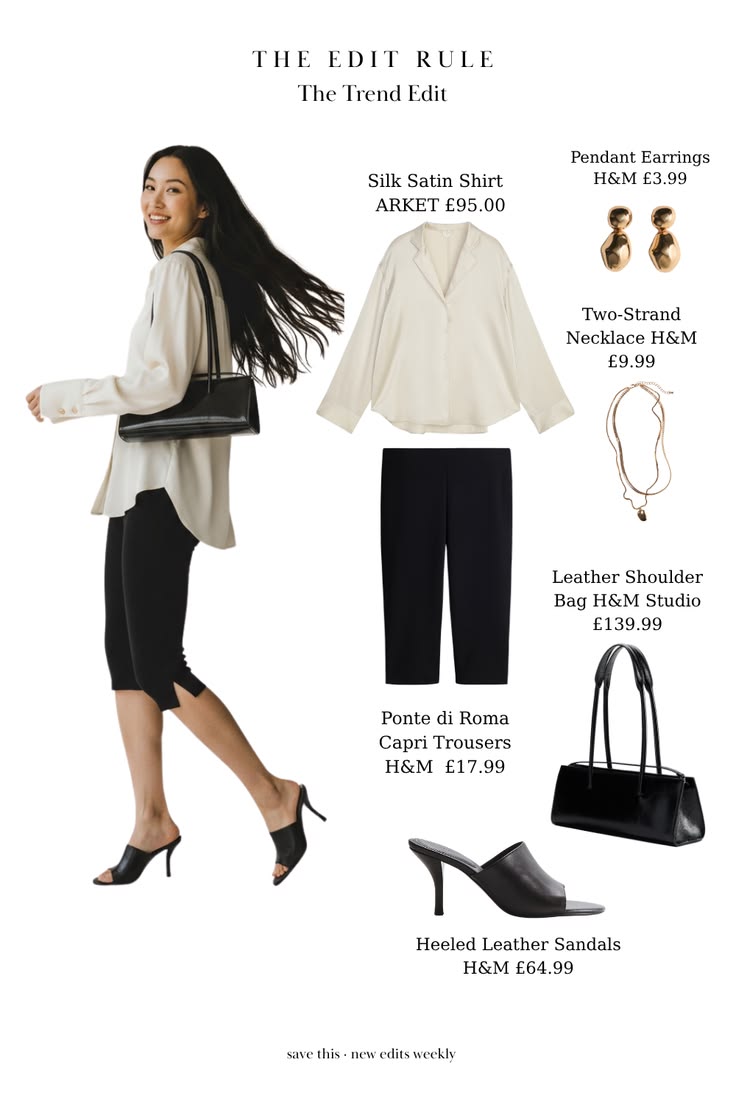
There is a particular outfit that keeps surfacing every time the fashion week crowd steps outside the venue. A fluid satin shirt, a cropped tailored trouser, a low heeled sandal, and almost nothing else. No print, no logo, no visible effort.
It reads as expensive, and often it is. But the reason this off duty model outfit works has very little to do with what it cost. It is a formula, and formulas can be rebuilt.
The reference
Think of the off-duty uniform worn by the likes of Sofia Richie Grainge and Rosie Huntington-Whiteley: a liquid shirt in an off-white or oyster tone, tucked loosely into a cropped black trouser, finished with gold jewellery and a structured shoulder bag. Search either name and you will find a dozen versions of the same three decisions.
The anatomy of the look
Strip it back and the outfit is doing four things. Once you can name them, you can rebuild it with whatever is already in your wardrobe.
One fluid fabric against one structured one. The satin moves, the trouser holds its line. That contrast is what stops the outfit reading as either sloppy or stiff. Swap either half for the same texture and it falls apart: two fluid pieces is loungewear, two structured pieces is a suit.
A visible ankle. The cropped or capri length is not a styling accident. Breaking the leg line at the narrowest point is what stops a flat or low heel from shortening the whole silhouette.
A tonal palette, not a matching one. Off-white, oyster, bone and black. Three shades sitting close together and one anchoring the bottom. Nothing here is trying to coordinate, which is exactly why it looks deliberate rather than assembled.
Gold, and only gold. One metal, repeated. Earrings, a thin chain, the bag hardware. Mixing metals is not a crime, but consistency is the simplest way to make an outfit look finished.
The tuck is the whole outfit
If there is one detail worth practising, it is this one.
The shirt is not tucked in fully and it is not left out. It is tucked loosely at the front only, with enough fabric pulled back out to sit softly over the waistband. A tight full tuck makes satin cling and shows every seam underneath. No tuck at all removes the waist entirely and the trouser length stops making sense.
Front tuck, then pull an inch back out. That is it, and it is the difference between this outfit and the version that does not work.
Where people get it wrong
Buying satin that is too shiny. The version that works is closer to matte, with a slight sheen in movement rather than a permanent gloss. High shine reads as evening regardless of what it is worn with.
Getting the trouser too tight. The trouser needs to hold a line, not trace the leg. A cropped trouser with a little room is what balances the fluid top half. A skinny one turns the outfit top-heavy.
Adding a fifth thing. The formula has four decisions. A scarf, a print, a second metal, a bright bag: any of these and it stops being this outfit and becomes a different one that works less well.
What to look for on the high street
The shirt: a poplin or satin-weave in off-white, oyster or bone, cut relaxed through the body. Not white. The slight warmth is what keeps it from looking like a work shirt.
The trouser: cropped or ankle length, tailored, in black or charcoal. Straight rather than tapered.
The shoe: low block heel or a flat sandal in a dark neutral. The heel height is doing less work here than the ankle is.
The bag: structured, shoulder length, plain hardware. If the hardware is silver, switch the jewellery to silver and keep the rule intact.
Already own most of this
If you have built the ten-piece capsule, you are closer to this outfit than it looks. The white poplin shirt stands in for the satin one on any day that involves actual work, and the tailored trouser is doing the same job in both wardrobes.
That is the useful thing about copying a look properly. You are not buying an outfit. You are learning where the tension sits, and then finding it again in clothes you already have.
Living with satin
The practical objections to this outfit are all about the fabric, and they are fair ones.
It creases. Less than you expect if it is a satin weave rather than pure silk, and considerably less if it is hung immediately rather than folded. The creases that matter are the ones across the lap from sitting, and they drop out within an hour of hanging.
It shows everything underneath. True, and the answer is a seamless vest in a tone close to your skin rather than white. White under off-white is visible in daylight in a way most people do not check for.
It is cold. Also true. Satin has no insulating value at all, which is why this outfit belongs to spring, summer and heated indoor autumn rather than to January.
Washing. Cold, gentle cycle, inside out, and hang while damp. Never tumble dry: heat is what takes the sheen off permanently, and once it has gone it does not come back.
If all of that sounds like more maintenance than the outfit is worth, the poplin version is genuinely almost as good and behaves far better. The formula does not require satin. It requires one fluid fabric, and a soft-washed cotton qualifies.
Making it work for an office
The version described here is off duty by definition, which means it needs adjusting for a workplace rather than copying directly.
Three changes cover most environments. Button the shirt one higher than the photographs suggest. Swap the flat sandal for a loafer or a low court shoe, because an exposed foot reads differently at a desk than it does on a pavement in June. And add the blazer, which converts the whole thing without disturbing any of the four decisions underneath.
What stays: the tuck, the ankle, the single metal, the tonal palette. Those are the parts doing the work, and they survive the move indoors unchanged.
What survives substitution
The formula tolerates more change than it looks. A longer trouser works if the heel stays low and the hem stays clean. A fine knit in place of the satin works if the trouser stays sharp. A flat works everywhere.
What does not survive is losing the contrast. Two soft pieces together and the whole thing reads as pyjamas, however good the individual items are.
That is the rule worth taking away, and it applies well beyond this one outfit.
Once you start looking for it, the same contrast turns up everywhere in the outfits that work: a knit against tailoring, denim against silk, leather against wool. One thing that moves and one thing that holds. It is the most reliable styling principle there is, and it costs nothing to apply to a wardrobe you already own.
The shopping list at the top of this page is optional. The tension between the two fabrics is not.
Keep reading
Save this edit
Pin it to your board so it is there the next time you are standing in front of the wardrobe. Save to Pinterest