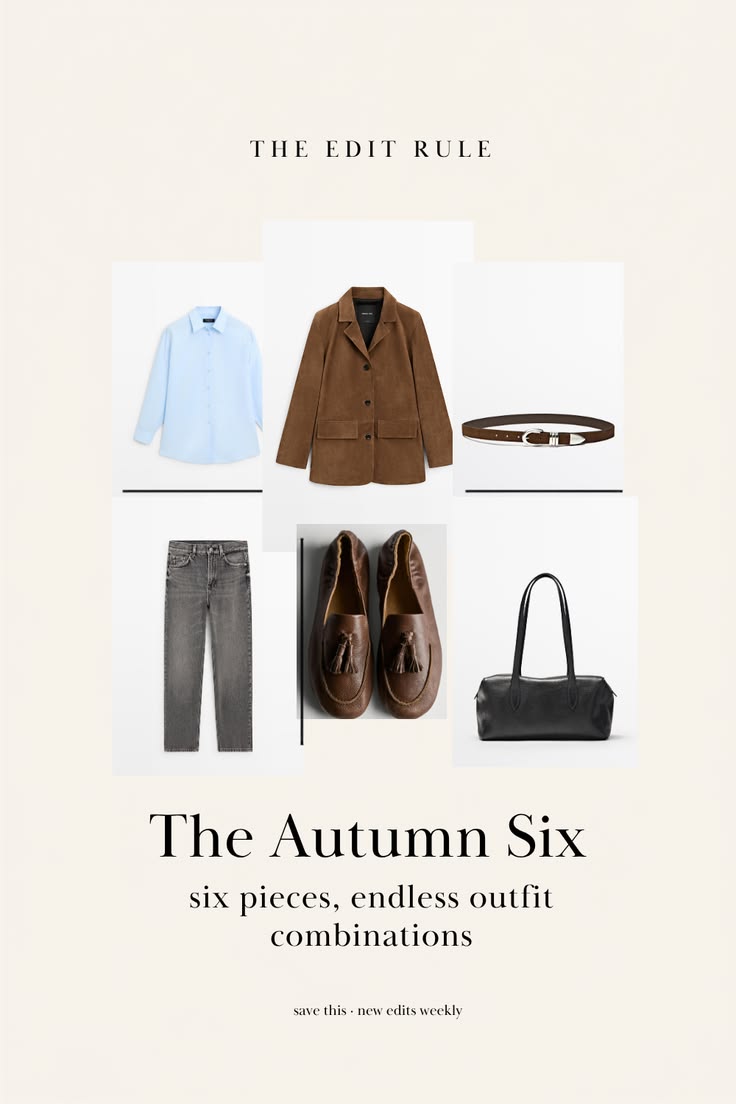
British autumn is not a season so much as an argument. September starts at twenty degrees and ends at nine. It rains in the morning and clears by two. You leave the house needing a coat and carry it home over your arm.
An autumn capsule wardrobe for the UK has to solve for that specifically, which is why most seasonal edits written elsewhere do not survive contact with a Tuesday in Manchester. The six pieces below work because they layer, and because none of them commits you to a temperature at eight in the morning.
The six
A suede blazer. A poplin shirt. Straight-leg jeans. A leather belt. Tassel loafers. A crossbody bag.
Notice what is not here: a heavy coat. That comes in November. September and October are layering months, and a coat bought in early autumn is usually the wrong weight by the time it is genuinely needed.
1. The suede blazer
The single most useful autumn piece, and the reason is texture rather than warmth.
Suede reads as seasonal in a way that wool does not quite manage in September. It looks right at eighteen degrees and it looks right at eleven, which is the entire problem this list is solving. In tan or chocolate it also introduces the warmth that a summer wardrobe of cream and white is missing.
Practical note: suede and British rain are not natural allies. Spray it before the first wear and keep it for days that are merely grey rather than actively wet.
2. The poplin shirt
The layer that does the most work for the least bulk. Under the blazer on a cold morning, on its own by lunchtime, open over a vest if the afternoon turns.
Blue or white both work. Blue is slightly more forgiving under autumn light, which is flatter and greyer than most people account for when they buy in a brightly lit shop.
3. Straight-leg jeans
Dark rinse, straight leg, full length rather than cropped. The ankle that looked deliberate in August looks cold in October, and a full-length jean with a loafer is the autumn version of the same proportion.
4. The leather belt
Small item, disproportionate effect. It marks the waist when a shirt is tucked, and it ties the outfit’s browns together: belt, blazer, loafer, bag. Four points of the same tone reads as a considered outfit even when the individual pieces are plain.
Match the belt to the shoe rather than the bag if you have to choose. It is the pairing the eye checks first.
5. Tassel loafers
A loafer with a detail, because autumn is the season where a completely plain shoe starts to look underdressed against heavier fabrics.
Leather sole or rubber is worth thinking about. Leather looks better and is a genuine liability on wet pavement. For a British autumn, rubber, and accept the small aesthetic compromise.
6. The crossbody bag
Hands free, because autumn involves carrying an umbrella, a coffee and quite often the coat you no longer need.
A crossbody in the same brown family as the belt and shoe finishes the tonal work the belt started. Keep it small. A large crossbody sits awkwardly over a blazer and pulls the shoulder line down.
How the six layer
The system has three settings and you can move between them without going home.
Cold morning: shirt, knit if you own one, blazer over the top, everything buttoned.
Mild afternoon: blazer off and carried, shirt sleeves rolled twice, belt visible.
Damp evening: blazer back on, collar up, hands in pockets. The suede handles a drizzle for the length of a walk to the station.
That is the whole design brief for British autumn dressing: one outfit that survives a fifteen degree swing without looking like it is trying to.
What to add in November
When the temperature stops recovering in the afternoon, two additions carry the same six through to winter.
A wool coat over the blazer, which is why the blazer should be cut close enough to layer under one. And ankle boots in place of the loafers, in the same brown family so the tonal logic holds.
Nothing else needs replacing, which is the point of choosing the six carefully in September.
Dressing for rain that has not started yet
The specifically British problem: it is not raining when you leave and it will be raining at some point, and you cannot dress for both.
The workable answer is to keep the rain protection separate from the outfit rather than built into it. A packable shell that lives permanently in the bag, and a compact umbrella that also lives permanently in the bag, mean the outfit never has to compromise.
The alternative, wearing a waterproof coat every day from September in case, means dressing for the worst version of the day for the whole of it. Most autumn days do not deserve that.
Two materials to think about. Suede stains permanently if it gets genuinely wet, so it needs the shell more than wool does. And leather soles become dangerous rather than merely uncomfortable on wet pavement, which is worth remembering when choosing the loafer.
The transitional weeks nobody plans for
Late August into mid-September is the hardest fortnight of the year to dress for, and it gets almost no attention because it is not properly a season.
The rule that helps: dress for the temperature at six in the evening, not the one at eight in the morning. Mornings are the exception in that fortnight and afternoons are the rule, and an outfit chosen for a cold morning is uncomfortable for the remaining ten hours.
A shirt with sleeves that roll properly does more work in those two weeks than any other garment, because it is genuinely two garments depending on where the cuff sits.
What to put away, and when
Autumn dressing is easier if the summer wardrobe is out of sight, and the reason is purely practical: you stop reaching for things that no longer work.
Late September is roughly right for the UK. Put away anything sleeveless, anything in linen, and anything in a bright colour that will not sit with the browns and charcoals the autumn palette is built on.
Keep back the cotton dresses and the plain t-shirts. Both become layering pieces rather than standalone garments, and both will be worn under things until November.
The mistake worth avoiding
Buying autumn clothes in August, when the shops are full of them and the weather is still summer.
The pieces that get bought in that window are almost always too heavy, because a heavy coat feels appealing in a cool shop on a warm day. Buy the layers first and the coat in late October, when you know what you actually need underneath it.
There is a second version of the same mistake, which is buying for the autumn you would like rather than the one you get. British autumn is mild, grey and wet far more often than it is crisp and golden, and a wardrobe built for the second version spends most of the season in the wardrobe.
Dress for drizzle at fourteen degrees. That is the actual weather, and the six pieces above are chosen for it.
Keep reading